Understanding coordinated listening. Without guessing why it happened.
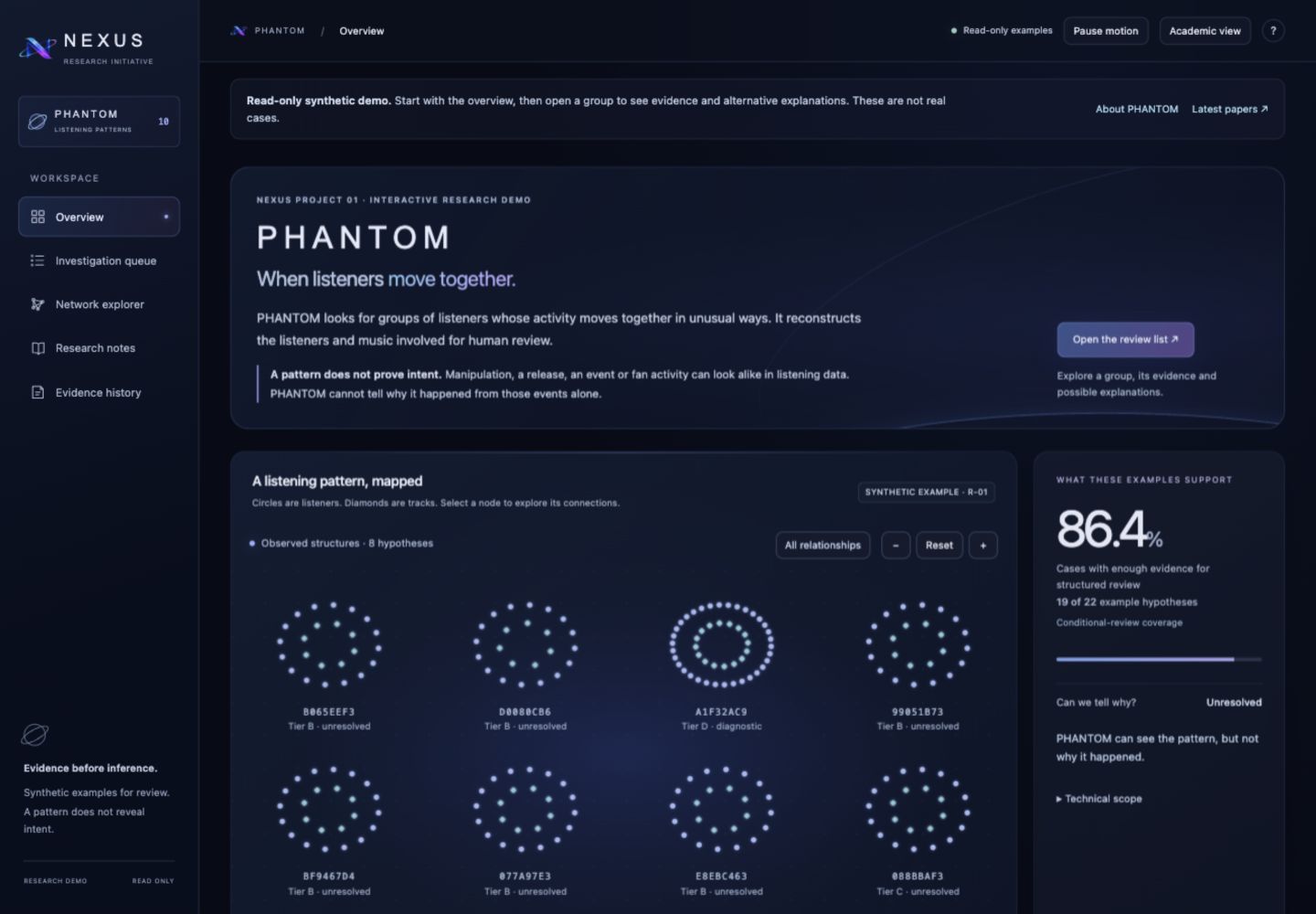
PHANTOM looks for groups of listeners whose activity moves together in unusual ways. It reconstructs the listeners and music involved, then shows the evidence for human review.
Listening events alone cannot prove why a pattern happened. A shared release, event, broadcast or fan activity can resemble manipulation.
The demo is a read-only example: explore synthetic groups, inspect their evidence and compare possible explanations.
By Nischit Girish KumarNEXUS Research InitiativeCompleted research · October 2026
The idea, in plain English
Listening together is a pattern. It is not an explanation.
What the research found
After rejecting misleading benchmark designs, PHANTOM separated deliberately planted listening patterns from matched controls in a controlled final test. But shared stimuli can resemble organized coordination, and stress tests exposed limits in reconstructing groups. Strong structural evidence can support an investigation; it cannot, by itself, establish intent.
THE PROBLEM
A platform can see activity, but not always its cause.
Many people may play the same music at similar times. An organized campaign could cause that pattern. So could a broadcast or another shared event. Listening records alone do not automatically reveal which explanation is right.
WHAT PHANTOM DOES
Find the structure. Assemble the evidence.
PHANTOM tests for unusual coordination, reconstructs candidate groups and the tracks they focus on, and brings the evidence and its limitations together for a person to review.
WHAT IT DOES NOT DO
Declare fraud or intent from events alone.
An alert is evidence of a listening pattern. It is not a verdict about who organized it, why it happened, or whether it was fraudulent. Those questions need additional context.
WHY IT MATTERS
A high score can answer the wrong question.
A flawed test can reward shortcuts instead of real detection. Even a carefully tested detector can mistake a shared response for manipulation if its result is interpreted too broadly.
How PHANTOM works
From listening records to a reviewable explanation.
Audit the data
Check data quality, repeated records and shortcuts that could make a test look more successful than it is.
Test for coordination
Compare timing patterns with carefully shuffled reference patterns that preserve specified listening totals.
Reconstruct the structure
Recover candidate listener groups and the tracks involved. Test this reconstruction separately from detection.
Stress-test other explanations
Challenge the result with shared events, overlapping groups and incomplete observations. Keep the failures visible.
Present evidence and uncertainty
Show a human reviewer the pattern, where it is supported, what remains unclear and which additional context could help.
This describes the research workflow. The public demo displays wholly synthetic examples; it does not run the frozen scientific detector or make decisions about real people.
The research story
Better tests changed what the system could claim.
01 / TEST THE TEST
Reject misleading success.
Early experiments produced attractive scores for the wrong reasons: generated activity, catalog differences or duplicate records were easier to spot than coordination itself. Those results were rejected.
02 / MAKE A FAIR COMPARISON
Change the alignment, not everything else.
Matched experiments preserved each listener’s track and timestamp totals while changing how listening aligned across people. This made the intended coordination pattern the focus of the comparison.
03 / CHALLENGE THE INTERPRETATION
Keep alternative causes in view.
A shared stimulus can produce the same visible pattern as an organized campaign. Better scoring cannot recover information that is absent from the listening records.
Technical detail: benchmark failures and changes
Reject shortcuts
Generated and observed activity differed before coordination was considered. Neutral and origin probes invalidated attractive early scores.
Preserve the comparison
Matched worlds hold declared actor marginals fixed: each listener’s item and timestamp totals are preserved. Collision checks caught a duplicate mismatch that would otherwise contaminate relational evidence.
Separate ranking from alerts
A raw score ranked treatments perfectly while alerting on 22 of 180 controls. Local permutation normalization (comparison with shuffled reference data from the same local setting) was evaluated to address source-specific baselines.
Keep the hard negatives
Popularity and release shocks alerted in all 12 moderate worlds per family. Shifted overlap reduced reconstruction F1 to 0.3636. A broad operating claim failed.
Change what the system reports
PHANTOM preserves evidence, missing context about its cause and equally supported alternatives. A structural alert does not become a finding of intent.
Controlled validation / May 2022 and September 2026
Strong results within a narrow experiment.
PHANTOM separated deliberately planted listening patterns from matched controls in both populations. These are controlled experiments on observed listening histories. Their labels describe the experimental intervention, not the intent of real listeners.
External controlled validation
May 2022 · ListenBrainz
4,032 listeners · 42 groups · 96 listeners per group 378 treatment/control pairs
AUC
1.000
Treatment alerts
378/378
Matched control alerts
0/378
Population holdout
September 2026 · ListenBrainz
A separate population and time window, with the same 42 × 96 sampling design: 4,032 listeners and 378 pairs.
AUC
1.000
Treatment alerts
378/378
Matched control alerts
0/378
AUC describes how well scores separate the two experimental groups. The worlds share 42 source groups and are dependent. No observed matched-control alerts does not establish an absence of alerts in ordinary listening. The holdout changes the population and time window; it does not establish broad coverage of coordination mechanisms.
How the September holdout was kept separate
The holdout protocol was fixed before access. Later development continued without accessing the September histories, and the pre-final manuscript was frozen before access. The separate September population was then materialized and scored. Exact execution timestamps and the full verification history remain in the provenance archive and Supplementary Appendix.
The canonical scientific evaluation ran once; planned deterministic replay covered all 756 worlds. The original verifier failed while serializing its receipt. A separate post-final forensic verifier checked the saved, unchanged results without rerunning population selection, intervention construction, the detector or null generation. Local chronology is not independent institutional verification.
Source audit, a separate part of the research
704,728,520 Deezer listening events audited.
This audit examined representation and data quality. Detector and reconstruction experiments used bounded subsets or separately sampled populations. The audit count is not detector throughput or the size of a deployment evaluation.
Reconstructing listeners and music
The average hides two difficult failures.
In a small historical internal holdout, PHANTOM fully recovered the listeners and tracks for 154 of 168 planted parent groups (91.67%). The pooled result masks severe degradation in the two hardest conditions below.
Gradual evolution · hardest level1/8
Parent groups fully recovered
Reduced participation · hardest level1/8
Parent groups fully recovered
Every other condition and level8/8
Parent groups recovered in each cell
All 14 missed parents occur in those two hardest cells. The result comes from two reserved Deezer blocks and 84 treatment/control pairs, with two planted parent groups per treatment. It is separate from the ListenBrainz detector evaluations.
Full recovery table and technical interpretation
Exact listener-and-track recovery in the internal holdout
Regime
Level 1
Level 2
Level 3
Broader targets
8/8
8/8
8/8
Distributed
8/8
8/8
8/8
Fragmented
8/8
8/8
8/8
Gradual evolution
8/8
8/8
1/8
Low signal
8/8
8/8
8/8
Reduced participation
8/8
8/8
1/8
Weak temporal
8/8
8/8
8/8
There were no partial member/target recoveries and no unmatched predicted candidates. Each parent contributes either one or zero to the reported member precision, recall, F1 and target F1, giving the shared mean 154/168. This is exact-set recovery in this holdout, not general accuracy. Missing a group is also distinct from withholding a claim about its cause.
Broader operating claims did not hold up.
Common-stimulus, popularity-shock and release-event controls can trigger structural alerts. Shifted group overlap also weakened reconstruction. These failures rule out broader operating claims from the tested evidence.
What listening events cannot tell us
Two causes. The same visible events.
Intentional coordination
An organizer asks a group to align its listening.
A shared external stimulus
A recurring broadcast prompts the same listening.
→
Identical users, tracks and times
If the available listening records are exactly the same in both cases, a method that sees only those records has no evidence that distinguishes the causes.
PHANTOM uses these “causal twins” to apply an established limit on what observations can identify to coordinated-listening analysis. This does not mean every real case is ambiguous. Information about exposure, referrals or an organizer could change the investigation.
The event-only identifiability limit
If all permitted observations are identical, an event-only method receives no information that separates the two accounts. Randomness independent of the cause cannot add it. This is a concrete application of established observational-equivalence reasoning, not a new general theorem or a claim that every real case is ambiguous.
Explore the research interface
Evidence a person can inspect. Uncertainty they can see.
The read-only demo shows candidate groups, the evidence behind them, the limits of that evidence and alternative explanations. It keeps equally supported alternatives together so a reviewer can see what the data leaves unresolved.
Five historical synthetic runs. No protected final records. No enforcement action or scientific recomputation.Technical detail: preserving ambiguity in the interface
The read-only dashboard keeps support status, constituent evidence, causal alternatives and missing provenance together. Complete ambiguity sets (groups of alternatives equally supported by the available evidence) retain equal scientific priority through filtering and export.
Go deeper
Read the evidence. Keep its scope in view.
The contribution is an auditable account of where coordinated-listening evidence is useful and where its interpretation fails. The papers preserve the methods, results, rejected approaches and remaining limitations.
No matched empirical CopyCatch, CatchSync or FRAUDAR baseline was run. No analyst study or production deployment was evaluated. The research does not establish comparative superiority or intent from listening events alone.